Showing posts with label William Morgan. Show all posts

Friday, August 1, 2014

Martha Matilda McGill Nelson - Life Story Part Nine

Martha Morgan:A Journey to Zion
Story by Allen Morgan Kendall
Pictures added by Lois C. Berrett


Life in Levan
William Morgan was one of the two men given responsibility for temporal affairs in Levan by Elder Erastus Snow. Each family was allotted half a block, or 2.5 acres of land within the town boundaries, as well as twenty acres farm and pasture land outside. William and Martha selected a lot at what was then the center of town at the southwest of the junction of Main Street (now 1st West) and Canyon Lane. Here William built a log house, consisting of three rooms, all in a row. The roof was constructed of cottonwood sticks supporting a layer of clay and straw, covered with a layer of soil.39


The Morgans shared their block with Jacob Hofheins, Mormon Battalion veteran, his two wives and large family. The Hofheins family had lived in Parowan and had been part of the first group sent to support the Iron Mission. They had also moved from Chicken Creek and so the two families were undoubtedly well acquainted. In the years to come intermarriage would make them closer yet.40

The United Order was introduced into the Levan Branch in 1875. In late October and early November, William and Martha entered into the Order by covenant through the token of baptism. Children Martha Ettie, James Nathaniel also joined, as well as married son Daniel with his wife. A total of 113 persons joined the United Order at that time, with the number increasing to 273 by 1878. In spite of growing numbers, the Order eventually ceased to function in Levan, as it did in most Utah communities where it was attempted.41

1870 Census

The United Order 
From the Encyclopedia of Mormonism:
"United orders" refers to the cooperative enterprises established in LDS communities of the Great Basin, Mexico, and Canada during the last quarter of the nineteenth century in an effort to better establish ideal Christian community and group economic self-sufficiency... Economic goals of consecration included relative income equality, group self-sufficiency, and the elimination of poverty. Under this plan, the head of each family would consecrate or deed all real and personal property to the
Presiding Bishop of the Church and would receive, in turn, a stewardship, or "inheritance," from consecrated property. Thereafter, Church members would consecrate annually all surplus production from their stewardship's to the bishop's storehouse.

Here in Levan their last son, Ira Robert Morgan was born, 25 February 1868.
Ira Robert Morgan


William Morgan appeared before the First Judicial Court in Provo in October 1871 and became an American citizen.42 By virtue of her marriage to William, Martha now became an official citizen herself, renouncing legally her allegiance to Queen Victoria of the United Kingdom.

After years of sacrifice and travel, the Morgans were settled into a pastoral lifestyle on land of their own, surrounded by family. It was to be altogether too brief.

If family tradition is correct, William suffered from the symptoms of asthma.43 There can be no doubt as to the source of his affliction. A glance at the history of his fathers, and his own occupational experience in the mines tells the story. His decline would have been gradual, the great strength from years of hard labor being sapped by his respiratory weakness. William Morgan died on 24 November 1876 in Levan.44  He was 59 years old when the cold specter of the coal
mine which had haunted generations before him finally claimed his life also. He was buried in the cemetery southeast of the town. It was the location he himself, as one of the city fathers. had helped to select just a few years earlier.45


Martha was 52 years old and a widow. Within two years she suffered further sorrow when she
lost her dear sister Jane, still living in Beaver and a highly respected midwife, to a relatively
early death.46

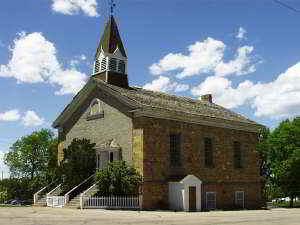
She remained in Levan for the rest of her life. She watched from under the shade of the fruit trees planted by the hand of her husband47 as the plot of tall blue grass grew into an industrious little town. Many businesses sprung up, including a broom factory operated by son Daniel.48 She witnessed the raising of three church meeting houses, from the simple log structure a few blocks north of her home, to the present stately brick church with gothic windows, under construction when she died. And before the end of her life, even the miracle of telephone had reached this former frontier settlement.49


Martha's life was certainly one of industry. While her sons toiled in the fields, she would have supported them planting and harvesting gardens, preserving fruit from the orchard, cooking and
mending. Wrestling with the notoriously hard water coming from the canyon springs must have been a massive chore on wash day in and of itself. It was a life of labor, but that had become the only life Martha knew.


Friday, July 25, 2014

Martha Matilda McGill Nelson - Life Story Part Eight


Martha Morgan:A Journey to Zion
Story by Allen Morgan Kendall
Pictures added by Lois C. Berrett

Life in Beaver 
As the impracticality of iron production at Cedar City became more apparent, the population decreased sharply. There were about 1000 residents in 1855, but by 1860 only about 400 remained.  Among those leaving were the Andrew and Jane Patterson family. Early in 1856 they were among the first of the settlers moving 36 miles to the north to a location on the Beaver River.30
Beaver River
When the Morgans left as the iron works closed, they joined the Pattersons in Beaver.

Mt Baldy viewed from Beaver in 1872


As the 1860 census was taken William was listed, no longer as a miner, but as a farmer. Also on this census William and Martha possessed something that would probably have never been theirs if they had remained in Scotland: $350 in real property.31


Here Martha gave birth to another son on 22 January 1860. She named him John Athos Morgan.32 The middle name given to the lad is interesting. Not a family name, it makes one wonder if Martha had developed a literary interest. Athos, of course, was the name of one of the fictional Three Musketeers in Alexander Dumas' 1844 novel of that title. Perhaps the book she was holding in her elderly portrait was more than a prop, but an icon of her interests to those of a later generation.
John Athos Morgan


Beaver was a beautiful location, hunting and other natural resources were abundant. The settlement was growing rapidly, ironically, due to the Utah War. Pres. Young had called many church members who were living in the corridor between there and San Bernardino, California back into the Utah Territory. Many of them found Beaver a desirable place to live.

The Morgans apparently found it desirable to move on.

Chicken Creek
Chicken Creek was a location that seemed ideal for a permanent home. It was located on the main thoroughfare through the Utah Territory about 15 miles southwest of Nephi, and no doubt many weary travelers to parts south, such as Cedar City, stopped there to rest from their journey. They must have found the shade of the cottonwood trees and thick willows, and the abundant flow of the creeks merging there very appealing.
Chicken Creek


After leaving Beaver, the Morgans were among a small group who attempted a settlement in the location of Chicken Creek. Once again they started from scratch. They were living there in 1862 when Martha gave birth to a daughter, Martha Ettie on 24 August 1862.
Martha Ettie Morgan
And where there yet when another son James Nathaniel was born on 2 October 1864.33

James Nathaniel Morgan


The Morgans helped to build a community in Chicken Creek. They had erected a meeting house which doubled as a school and social hall. They had put in gardens and wheat fields. But Chicken Creek was still not to be their permanent home. It must have been with some disappointment that they concluded that the location that looked so ideal was unsustainable to their needs. The soil was actually quite poor, and the growing season too short to allow the cultivation of fruit trees. The water dwindled in the fall, and locusts often devoured what crops could be raised.34 

There were still Indian conflicts.  In May of 1866, most of the residents moved temporarily to the fort in Nephi as a defense against attacks, but returned for the harvest in the fall.35


Sources: 
30. Dalton, Luella. History of Iron County, p. 200. Family History Library, Salt Lake City, Utah.
31. Ancestry.com. 1860 U. S. Federal Census [Database on-line]. Provo, Utah, USA: Ancestry.
com Operations Inc. 2009
32. LDS Church Membership Records.
33. ibid
34. Stephensen, Maurine. A History of Levan, p. 5. Chicken Creek Camp, Daughters of Utah Pioneers.
35. McCune, Alice P. History of Juab County, p. 152. Juab County Company, Daughters of Utah Pioneers. 1947.

Friday, July 18, 2014

Martha Matilda McGill Nelson - Life Story Part Seven

Martha Morgan:A Journey to Zion
Story by Allen Morgan Kendall
Pictures added by Lois C. Berrett


The Iron Mission 
The trip to Salt Lake City may have begun more than the eternal continuation of their marriage. To understand this, we must understand the Iron Mission. When Apostle Parley Pratt led exploration far to the south of Salt Lake valley one of the important discoveries made was that of iron ore. It provided an exciting potential resource to a people striving to become independent of the iron products being shipped at dear prices from the east. In 1851 a company of pioneers were sent to what was then called Little Salt Lake Valley, 250 miles from Salt Lake proper with the specific mission to establish an iron industry for the support of settlements in the Great Basin and surrounding areas. The initial settlement was Parowan, but 

Church in Parowan
the iron works were set up 20 miles to the southwest in Parowan. A fort was built there called Fort Cedar, and it grew into the town of Cedar City. It was selected because of coal to the east and iron ore to the west.

The mission struggled valiantly from the beginning. Between snow and ice, drought, Indian attacks, and poor quality coal, the production of usable iron seemed nearly out of reach. But they persisted for years. As late as June 1855, Pres. Brigham Young was still calling for experienced European iron workers to go to the Little Salt Lake Valley.26

This may have prompted the Morgans to move there. During their visit to Salt Lake City William may have received a call to serve in the coal mining operation when Elder Pratt and others were reminded of his experience. Or he may have been persuaded by brother in law Andrew Patterson, who was already serving there. One thing is certain, there was little personal advantage to their family. They were probably looking forward to settling permanently in Nephi with the dream of a little farm of their own at the base of majestic Mount Nebo. The move to Cedar City was a call to duty, a faithful response to the consideration of the sacred covenants they had just made.

The Morgans were in Cedar City by 1856. Their presence there was again marked by the birth and death of another child. Thomas William Morgan, less than 6 months old, died there on 20 September 1856.27

Although conditions in the iron works had improved since the beginning, in which workers were clothed in rags and sometimes shoeless, these were still difficult years. Payment for workers was made in kind through the store of the Deseret Iron Company, and requisitioned payments usually exceeded store inventory. Coal Creek flooded frequently and inundated the iron works. 
Drought and grasshopper infestation in 1856 began a serious decline in the operation. The Utah War in 1857 sounded the death knell for the iron works with its disruption and draw upon resources. The tension in the area was further increased by the Mountain Meadows Massacre in September of 1857. The operation finally closed in 1858.28


From a practical perspective, the Iron Mission was a failure. But for the Morgan family and the others who sacrificed greatly in this effort much more than iron was produced in the fiery furnace which burned there. Once again the character of the saints who gave much was forged to a more perfect form in a test which could have made them or broken them. The cooperative operation of the church functioned throughout their time there. In 1856 a Female Benevolent Society (Relief Society) was
organized in Cedar City. Martha Morgan would have been a part of it. Martha gave birth to a healthy son there, on 1 Oct 1857, and named him in honor of her father Edward Nelson Morgan.29


26. Shirts, Morris A. A Trial Furnace. Brigham Young University, University Publications. 2001.
27. LDS Church Membership Records.
28. A Trial Furnace.

29. LDS Church Membership Records.

Friday, July 11, 2014

Martha Matilda McGill Nelson - Life Story Part Six

Martha Morgan: A Journey to Zion
by Alan Morgan Kendall
(pictures and documents added)


Life in Nephi 
The first settlers came to Salt Creek in October 1851, so when the Morgans arrived the next
year, things were still just getting started. [Salt Creek is east of Nephi, Utah]

Salt Creek Canyon

     William and Martha left few records of their time in Nephi. One can be sure that they were more concerned with surviving than with leaving a history of it. William was now challenged with becoming a farmer rather than a miner. Fortunately, he had some experience of working in the fields as a youth, but it must have been, none the less, a learning experience for the entire family.

A sad reminder of their stay in Nephi is a tiny grave. Martha gave birth to a daughter, Mary Ann Elizabeth in 1853, but she lived for only just over a year.23
Their sadness must have been offset by being involved and working cooperatively with the Saints in Nephi. It was now not only what they had sought for in leaving their native land, but necessary for their survival. They received further comfort and reassurance in August of 1854 when William Cazier laid hands upon them and pronounced a patriarchal blessing, declaring them to be descended from the noble tribe of Joseph, and revealing other aspect of God's will that would comfort them in their journey yet to come. Both William and Martha received their blessings at this time, as well as their older children Catherine, 12, and Daniel, 10.24  

[I have William and Martha's patriarchal blessings, if any of you want them, please get in touch with me or leave a note in the comments and I will see that you get one.  They are beautiful blessings.  However, Martha received her blessing after the death of William.  William received his in 1854 and Martha, her's in 1882] 

Sacred Covenants
The sacred endowment and the marriage sealing were the pinnacle of the eternal ordinances offered to the Latter-day Saints. Upon their arrival in the Salt Lake valley, the vanguard of pioneers under the direction of Brigham Young began  making preparations for the building of a temple for these holy purposes. As the completion of this or any temple was still years in the future, a means was provided for church members to receive the endowment. It was the Endowment  House, built on what is now temple square in Salt Lake City. 
Endowment House
It appears that William and Martha were anxiously engaged in the work of the Kingdom, and also anxious to receive their ordinances. The Endowment House was opened in 1855, and they

made the journey to Salt Lake City in September of that year. That was a trip of 90 miles and
probably took 4-5 days to complete. Travelers in those days frequently stayed with family or
friends in the evenly spaced settlements along the Wasatch front. Significantly, they were
joined by Andrew and Jane Patterson for the trip, who must have traveled all the way from Cedar
City, an even lengthier journey.

And so it was that the four of them and about twenty others, spent the day on 4 September 1855
in the endowment house, for it was an all day experience in those times. Among those administering the endowment were such luminaries as Heber C. Kimball, W. W. Phelps, and Eliza R. Snow. Another present who probably remembered the Morgans from his days in Scotland was Apostle Orson Pratt. At the conclusion of the day at 4 pm, as the sun hung low over the Oquihhr Mountains, William and Martha knelt at an altar in the endowment house and were sealed as husband and wife for eternity by Pres. Kimball. J. W. Cummings and W. W. Phelps acted as witnesses.25 

Sources
23. LDS Church Membership Records.
24. Index to Patriarchal Blessings: 1833-1963. Family History Library [FHL] Microfilm
392673, Family History Library, Salt Lake City, Utah.
25. Endowment House Records. Family History Library Special Collections [FHL] Microfilm
1149524, Family History Library, Salt Lake City, Utah.

Friday, July 4, 2014

Martha Matilda McGill Nelson - Life Story Part Five

Martha Morgan: A Journey to Zion
by Alan Morgan Kendall
(pictures and documents added)


The Journey to America 
The Morgan's traveled from Scotland to Liverpool, England in August to begin their sea voyage.
Their passage was actually paid by James Watson, an agent of the Church16. Some have
assumed this to be through the Perpetual Emigration Fund, but that program did not begin for
another month. Either way, it seems that the Morgans received some assistance on their ticket,
which may explain their future delay in arriving in Utah. William was probably resolved to
work off an obligation before proceeding to the valley.

Music Hall in Liverpool

In Liverpool, the Music Hall had been rented to receive the passengers until their ship was
ready, so the family may have stayed there for a time, making final preparations and last minute
purchases. On the first of September they boarded the James Pennell, the sailing ship that would
take them across the Atlantic Ocean. There were 250 LDS passengers, about half of them from
Scotland. One can imagine the busyness of preparing to get underway. William was probably
engaged in lashing down their trunks while Martha and Jane were preparing the bunks or cooking.  How wonderful and strange this must have seemed to the children. Journals of the trip describe a spirit of harmony among the saints, all working together for a common good.


On the morning of 2 September the James Pennell was tugged down the Mersey River to the
Irish Sea as nearly all the ships company was on deck, singing hymns. It must have been a bittersweet farewell to their native land. On the third day, they had cleared the coast of Ireland and were into the open sea, which meant the rolling and shifting of the vessel bringing on the agony of sea sickness.


The passenger's journals described the captain of the ship to be exceptionally considerate of his
passengers, and he successfully made efforts to provide a pleasant journey to those in his stewardship.  This was very fortunate, for they were underway for over 6 weeks. There was a violinist and accordionist on board as well as singers, so entertainment was available. The only cause for sorrow was the death of two sick babies. They also received a bit of a fright during a storm in the Gulf of Mexico, during which the top mizzen mast was broken off.


On the evening of 20 October, a steam tugboat fastened to the James Pennell and pulled her into
the mouth of the Mississippi River. The Morgans were probably up past midnight watching as
the ship entered this great river, and likely up at dawn the next morning, standing on the quarter
deck to get a better view of the strange plantations bordering either side of the river. They
reached New Orleans on the 22nd, and tied up to the levee. They were in America!17
New Orleans Dock 1849


After they disembarked, rental houses were provided for some, but most continued by steamboat
up the Mississippi to St. Louis, Missouri. On the way up the river the Morgans may have
discovered that coal mining was common in nearby Jackson County, Illinois. Jane Morgan
stayed in St. Louis with the Saints waiting to cross the plains, while William and Martha and
the children returned about 60 miles to the south, where William obtained work in the coal
mines there. He was earning money to get outfitted for the overland journey to Salt Lake City,
and probably to honorably settle the debt for passage over the Atlantic. A year later, the 1850
census shows the Morgans to still be living in the south district of Jackson County, with William
working as a miner.18 The sweltering Mississippi River summer of 1850 must have been a
new experience for Martha and the children. They may have missed the cool Scottish weather.


Crossing the Plains

The names of the Morgan family don't appear on any of the known rosters of pioneer companies
crossing the plains, so we can only speculate on when and how they made the trek. It does

seem reasonable, however, that they would have stayed close to sister Jane for the crossing.
Jane Morgan met and married another Scottish immigrant while staying in St. Louis. Her new
husband was recently widowed Andrew Patterson. They had undoubtedly known each other in
Scotland, as Andrew had been a member of the Dunfermline branch. They had made their way
to Council Bluffs, Iowa by May 1852, for their first child was born there19. It seems very likely,
then, that they all made the crossing in the summer of 1852.20

A William Morgan appears twice on the Annual Bishop's report of 1852. One, possibly this
William, in the Salt Lake 15th Ward, and another, very likely our subject, in the Nephi Ward.21
This suggests the scenario of the Morgans stopping briefly in Salt Lake City, with William laboring for public works temporarily to completely discharge the emigration debt, and then being called to strengthen the new settlement at Salt Creek, soon to be called Nephi.22 Jane Patterson and Andrew, an iron miner, were called directly to the Iron Mission in Cedar City. Their paths would cross again soon.


16. The History of the Morgan Family.

17. Mormon Migration, Liverpool to New Orleans, Ship: James Pennell. http://lib.byu.edu/
mormonmigration, 2011.
18. Ancestry.com. 1850 U. S. Federal Census [Database on-line]. Provo, Utah, USA: Ancestry.
com Operations Inc. 2009
19. Sly, Jeffery. Notes on Andrew Patterson, new.familysearch.org.
20. Jane and Andrew Patterson are thought to have crossed in the 1852 Higbee/Bay company
( Mormon Pioneer Overland Travel, 1847–1868 at www.lds.org) with her brother John Nelson
and his family. Her 18 Sept 1878 obituary in the Deseret News incorrectly states that she arrived
in Salt Lake valley 13 May 1852, but probably intended to say that their company left
Council Bluffs at that time.
21. Utah Bishops’ Report 1852. Family History Library [FHL] Microfiche 6051208, Family
History Library, Salt Lake City, Utah.